


Parking System Installation: How it Works and What to Consider
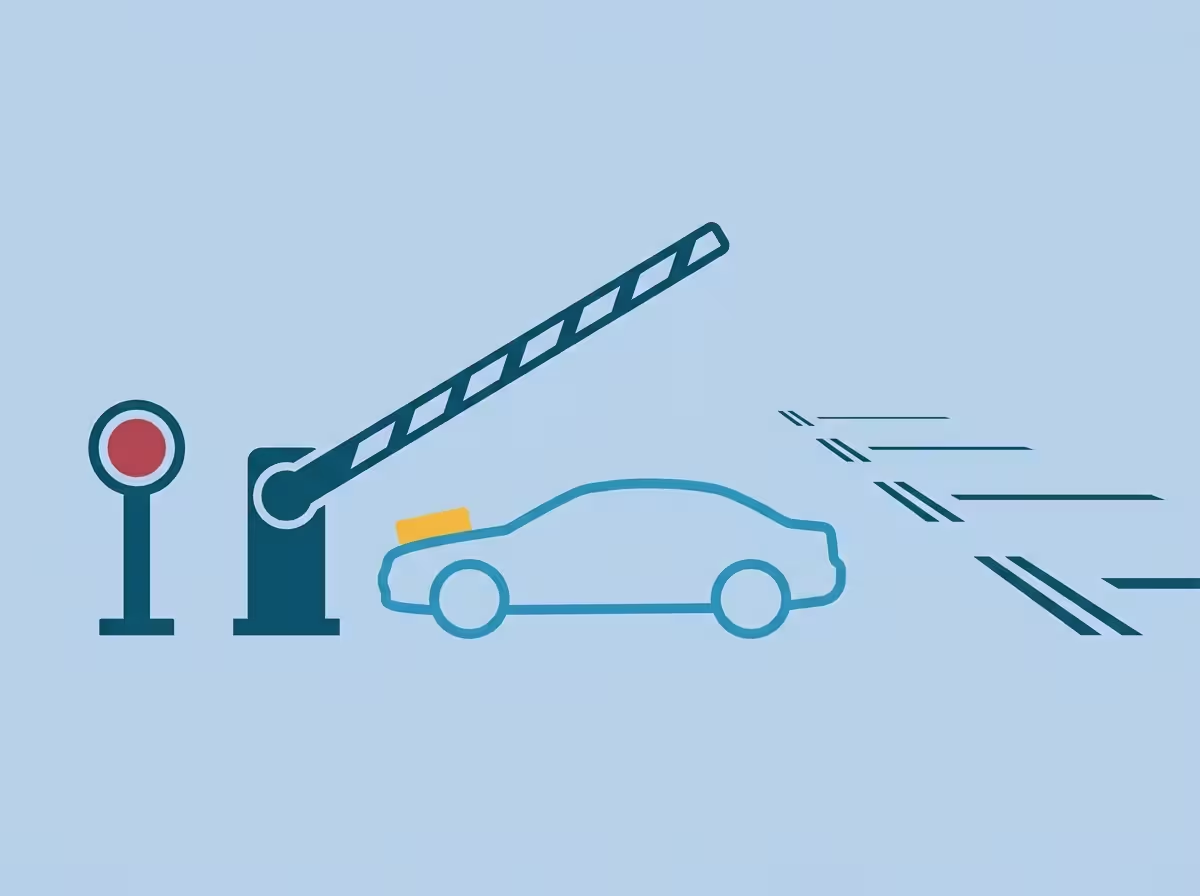
Tenant dissatisfaction due to unauthorized cars in the courtyard. Conflicts among employees over available parking spaces. Business center visitors leave the premises because they cannot find a parking spot.
The management company lacks accurate information on which tenant is actually using an assigned spot and who is paying in vain.
This is a typical scene for facilities in Tbilisi where a parking system has not been implemented.
A modern parking system automates entry, exit, and record-keeping. The barrier opens via a card, license plate recognition, or a smartphone signal. The software logs every event: which vehicle entered, at what time, and for how long. Visitors receive temporary access via a QR code or by calling an operator. Tenants receive monthly reports on their own transport. The management company, in turn, receives real-time data on parking occupancy.
For a shopping center, this is a tool to control visitor flow. For a business center, it serves as a service for tenants and ensures order on the premises. For a residential complex, it separates residents from outsiders. For an industrial facility, it ensures perimeter security and tracking of contractor vehicles.
That is why we are increasingly being approached with requests for parking system installation.
Basic Parking System Configuration
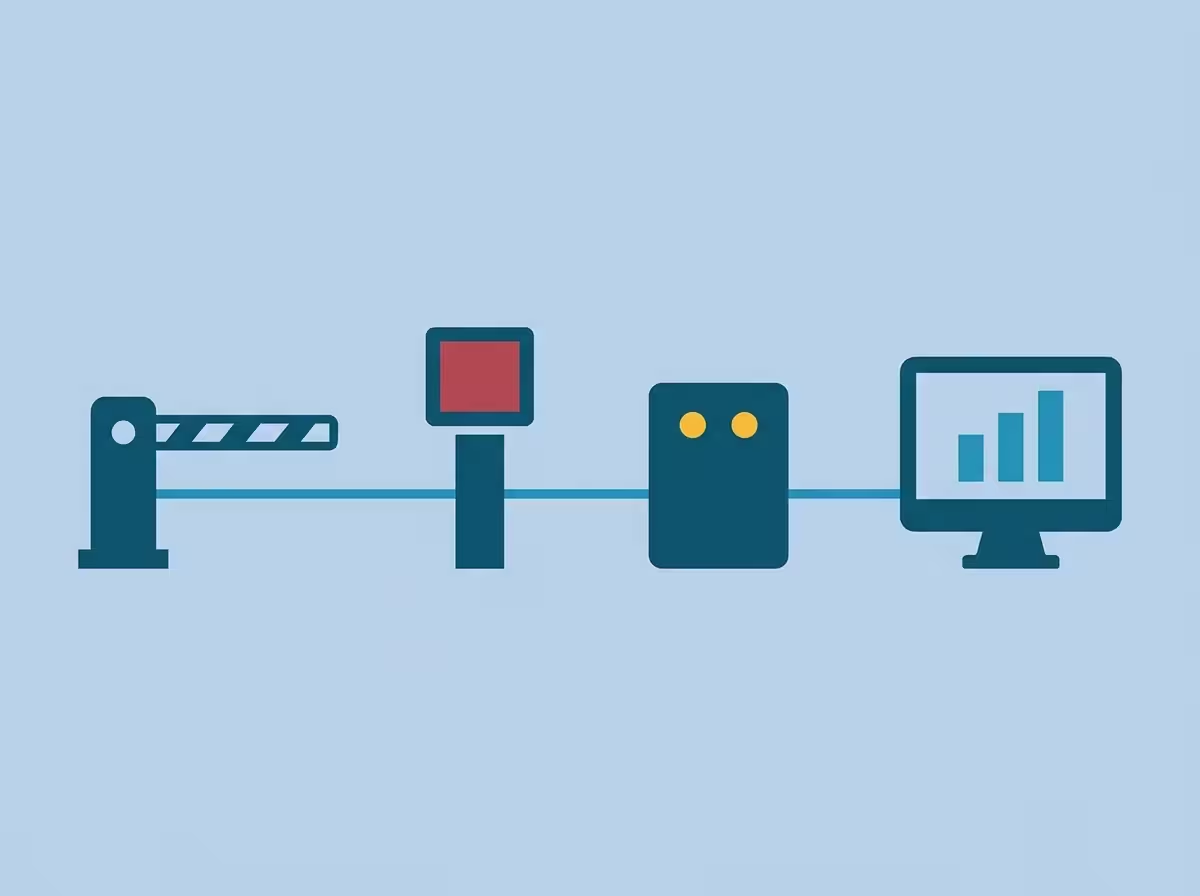
When installing a parking system, it is important to consider that the system consists of four main components. Without any one of them, the system will either not work at all or will function improperly.
Barrier (Boom Barrier)
A mechanical barrier that physically blocks the entrance. Barriers are available with straight or folding arms, ranging from 3 to 8 meters in length. Raising speed varies from 1 to 6 seconds: the more intense the traffic, the faster the barrier required. For a shopping center where 500-800 cars move per hour, a high-speed model is needed. For a business center with 50-100 cars per hour, a standard model is sufficient. The barrier operates in an outdoor environment, so the housing and motor are selected based on the climate and intensity of the load.
Reader
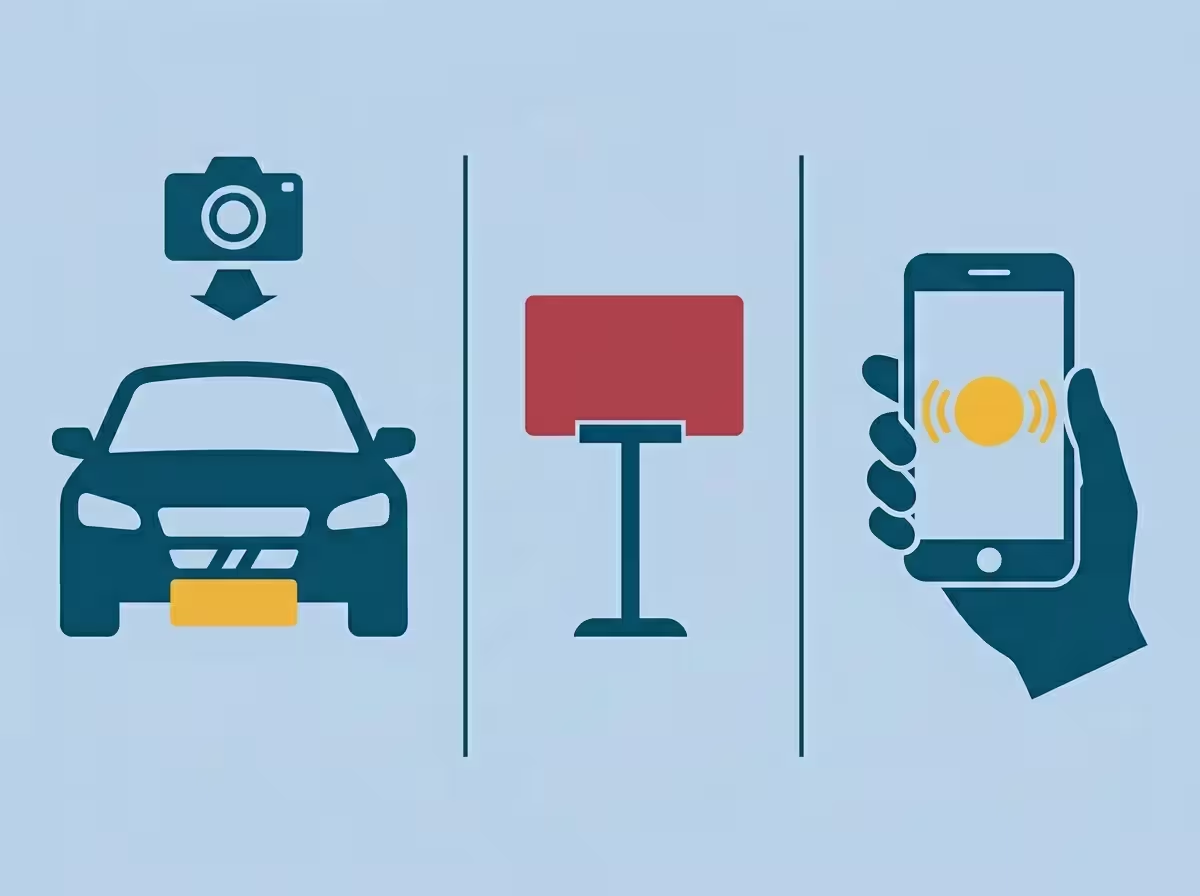
A device that identifies the vehicle or the driver. A card reader accepts the tenant’s plastic card. A license plate recognition camera reads the state license plate at the entrance. A Bluetooth reader receives a signal from a smartphone at a distance of 3-5 meters, without needing to open the window. It is possible to use two readers simultaneously at one entrance: for example, a license plate recognition camera for tenants and a card reader for visitors.
Controller
The electronic “brain” of the system. It receives a signal from the reader, checks if the vehicle is on the authorized list, and sends a command to raise the barrier. The controller stores the access database, the event log, and tariff data. It connects to the management company’s server via a network for remote administration.
Software
The system management interface. The management company adds and deletes access credentials, sets temporary restrictions (e.g., visitors only during working hours), generates reports for tenants, and obtains data on parking occupancy. In large facilities, the software integrates with tenant accounting systems or 1C.
Additional Elements
An induction loop detector embedded in the asphalt before the barrier detects the vehicle and protects the arm from lowering onto the car’s hood. Traffic lights regulate the flow at narrow entrances. A payment terminal is used for parking lots with hourly rates. A fire alarm release system forces the barrier to raise upon receiving a fire alarm signal.
License Plate Recognition, Card, or Smartphone
License Plate Recognition
The identification method determines user comfort, entry speed, and system cost. Three practical options are used in the Georgian market.
The camera captures the vehicle’s license plate as it approaches the barrier, the software compares it to the authorized database, and opens the entrance. The driver does not need to take out a card, roll down a window, or come to a full stop. The opening occurs within 1-2 seconds of recognition.
It is suitable for facilities where vehicle composition is stable: business centers with tenants, residential complexes, and company fleets. On facilities with visitor traffic, license plate recognition usually works in conjunction with another method: the visitor’s license plate number is temporarily registered with security via a call or an application.
Technical conditions: The camera is installed 4-6 meters away from the barrier. The shooting angle must ensure clear capture of the license plate. On high-traffic facilities, infrared lighting is used for operation at night and in bad weather conditions. The recognition accuracy of modern systems for standard Georgian license plates reaches 95-98%.
Cards and Key Fobs
A classic solution. The driver taps the card against the reader and the barrier opens. The card is inexpensive, programmed on-site, and can be handed to a new tenant in five minutes. The downside: you need to roll down the window and present the card to the reader, which is inconvenient in rain and winter. With an hourly flow of 200+ vehicles, cards create queues.
It is suitable for facilities where user composition rarely changes and traffic is low: small business centers, corporate parking, and warehouse areas for contractors.
Mobile Credentials via Smartphone
The driver approaches the barrier, the Bluetooth reader receives a signal from the smartphone via the application, and the barrier opens without contact. There is no need to roll down the window. The technology works at a distance of 3-5 meters, ensuring seamless entry without stopping.
It is suitable for facilities where service is important and handing out plastic cards makes no sense: premium-class residential complexes, business centers with international tenants, and hotels with guest parking. A hotel guest receives a pass via a link sent to a messenger, enters using the application, and after departure, the pass is automatically deactivated.
When to choose which configuration
For a shopping center with high visitor traffic — license plate recognition as the primary method and an automatic payment terminal at the exit. For a business center with tenants — license plate recognition for permanent tenants and temporary QR passes for visitors via a call to reception. For a residential complex — license plate recognition for residents and guest passes via an application or a call panel. For a small office’s corporate parking — cards or key fobs as the most economical solution.
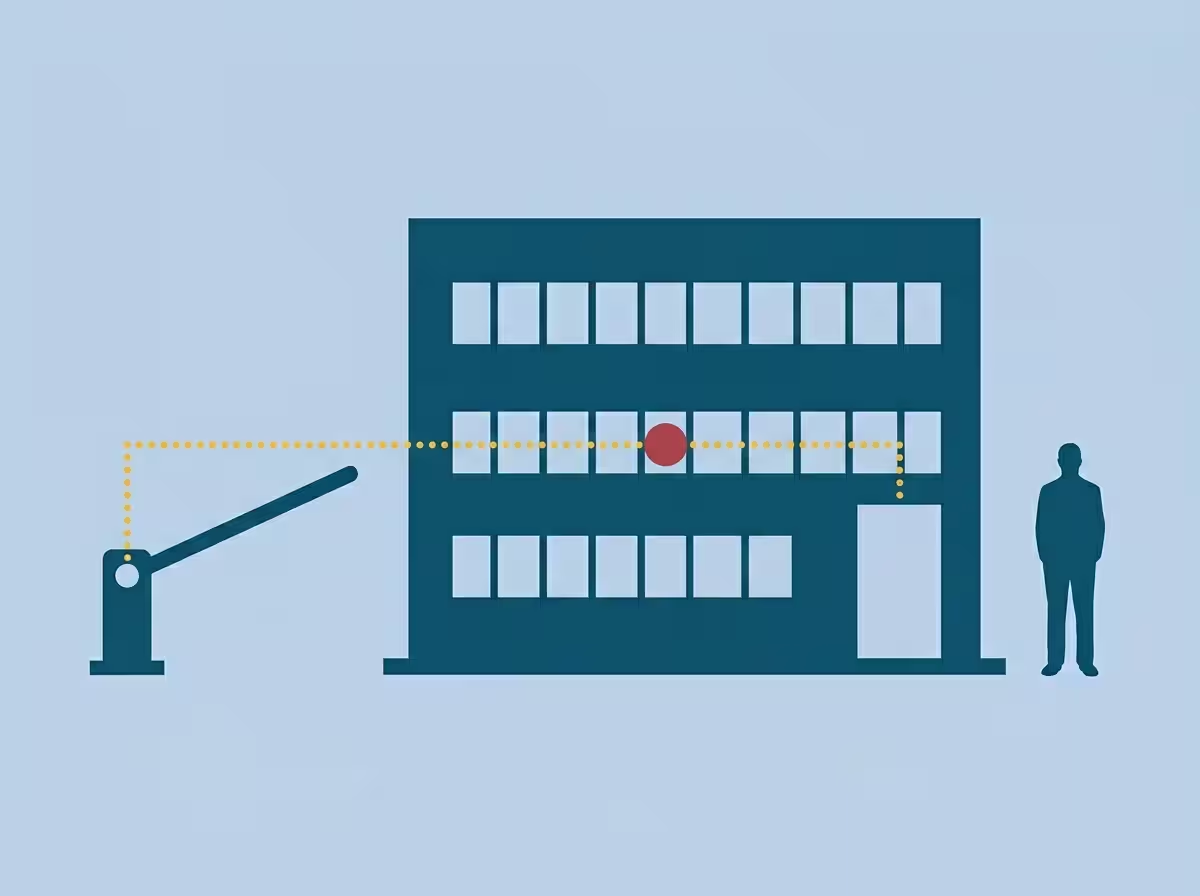
On large facilities, parking and building access systems work as a unified system. One credential opens both the barrier and the office door. In one account, you can see when a tenant entered the parking lot and when they went up to their floor. These are different layers of the same security infrastructure, not two independent projects. Therefore, it is recommended to order the parking system and access systems together so that the design is as consistent as possible.
Business center morning scenario: A tenant approaches the parking lot, the camera recognizes the license plate, and the barrier opens. Two minutes later, the same employee taps their badge at the office door and the door opens. The management company sees in one log: vehicle “GR-….-AB” in the parking lot at 9:14, and badge 047 on the fifth floor at 9:18. The record is transparent and works correctly.
Problematic situation scenario: An employee claims that they did not leave the parking lot at noon. The entrance camera shows that the vehicle left at 13:22 and returned at 14:47. The access system also records that during the same period, badge 047 was used at the exit and entrance. Two systems independently confirm the fact. Conflicts are resolved with facts, not words.
Technically, integration is carried out at the software level. The software of the parking system and the access systems run on one platform or exchange data via a standard protocol. Innotech combines parking systems and access systems in a connected configuration for one client. This is a typical solution for business centers and residential complexes.
What affects costs and timelines
Parking systems do not have a standard price. The cost is composed of several factors that are discussed during the site inspection and design stage.
Need for Time Tracking and Tariffication
If the parking serves only tenants with fixed rent, tariffication is not necessary. A database of passes and an event log are sufficient. If the parking offers paid services to visitors, a payment terminal with a screen and the functionality to accept cash and bank cards is required. This is a separate module that practically doubles the cost of the system.
Implementation Timelines
A typical project for a medium-sized business center: site inspection — 1 day, design and approval — 5-7 days, equipment delivery — 7-14 days, installation and commissioning — 10-20 days. On average, it takes 4-6 weeks from application to full operation. In large shopping centers and residential complexes, these timelines increase due to the scale of approvals and installation work.
Parking as a source of revenue, not just an expense

For facilities with visitor traffic, the parking system serves not only as a control mechanism but also as a source of revenue. In Tbilisi, the standard rate for commercial parking is 1-5 GEL per hour, depending on the location and the category of tenants. The specific rate is determined by the owner based on location and demand.
Example of a medium-sized shopping center: 50 paid spots, average 60% occupancy during business hours, an average rate of 2 GEL per hour, and 10 working hours per day. This yields approximately 600 GEL per day and about 18,000 GEL in total monthly revenue. With a typical investment in the system of 30,000-60,000 GEL, the return on investment is achieved in 3-6 months.
For business centers, the model is different. Parking remains free for tenants as part of the lease, while the visitor zone operates on a paid basis. This provides a service for tenants while simultaneously recouping the investment through visitors.
In residential complexes, visitor spaces are usually paid, while those for residents are free. This creates both order and an additional revenue stream.
Important note: Paid parking requires a payment terminal that supports cash and bank cards. This is a separate module that increases the project cost by approximately 8,000-15,000 GEL. The exact price depends on the manufacturer. Usually, this specific module justifies the investment fastest — within 1-2 months of starting paid parking operations.
What to prepare before contacting the integrator
To make the first conversation with the integrator productive, prepare five key pieces of information about the facility in advance.
First — the number of parking spaces and a layout of the territory. A screenshot of Google Maps with the boundaries of the territory or a hand-drawn sketch marking the entrances and exits is sufficient.
Second — the estimated flow of vehicles during peak hours. This affects the class of barrier and the number of entrance lanes.
Third — user categories: tenants only, visitors only, or mixed traffic. The identification method depends on this.
Fourth — whether payment for parking is required. If required, in what mode: hourly, daily fixed, or subscription.
Fifth — whether a video surveillance system and access systems already exist. If they do, the parking system will be integrated with them. If not, a unified project will be considered.
With this data, a call to Innotech will take 10-15 minutes, and by the time you order the parking system, you will already have an idea of the system’s composition, estimated cost, and timelines. Exact cost estimation is calculated after the design process is complete.
+995 595 532 112 Free site inspection in Tbilisi.
Author: Morris Melia Co-founder and CTO of INNOTECH, Tbilisi. 25+ years of experience in the field of IT and security technologies. Certified partner of Hikvision, Dahua, Uniview, and Teletek. Holder of Cisco CCNA and VMware VCP certificates. Personally led hundreds of projects for business centers, hotels, residential complexes, and industrial facilities in Georgia.