


Video Surveillance Systems for Business: IP vs. Analog — What to Order in 2026
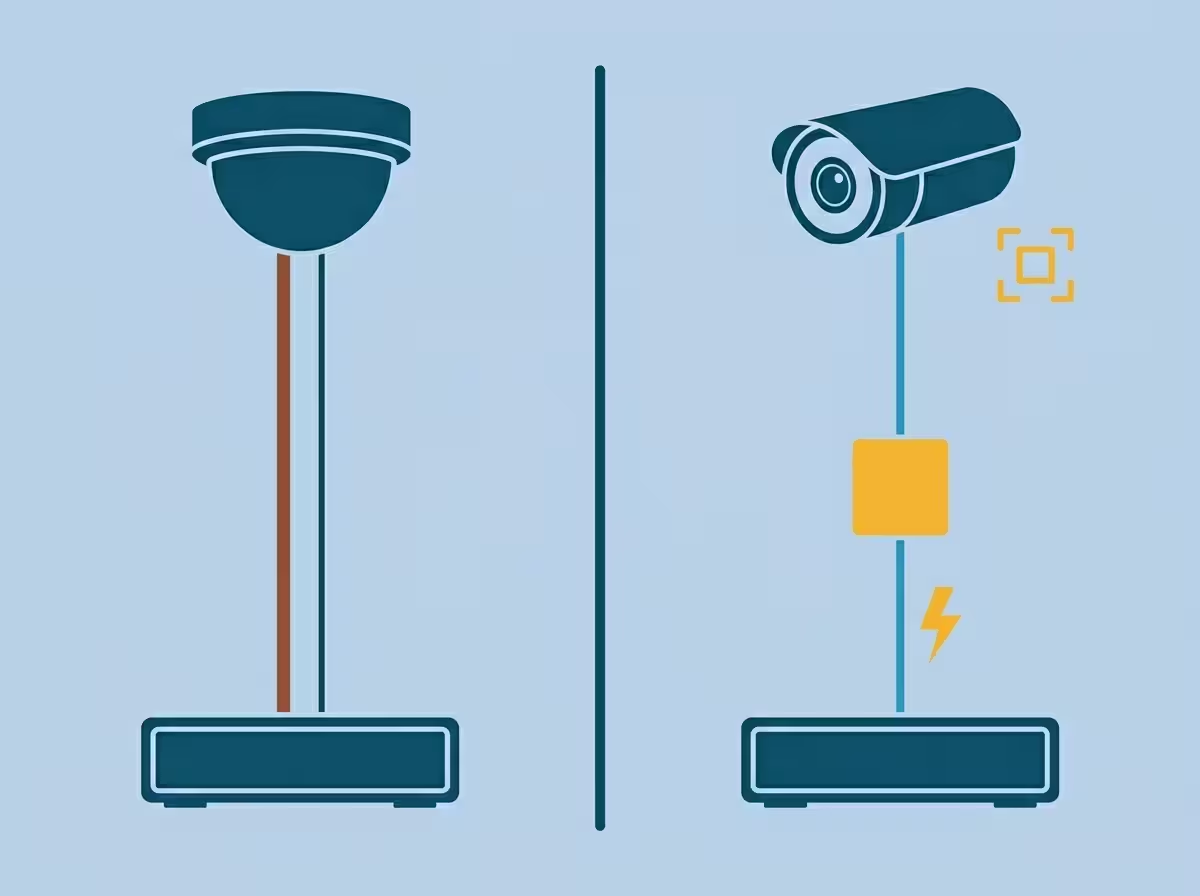
When designing a video surveillance system
for a business in Georgia, there is one main choice: an IP or an analog system.
Everything depends on this decision — the type of cable to be installed on the site, which recorder will be selected, the quality of the image the security team will receive, which analytics can be connected, and what the final budget will be.
A mistake made at this stage becomes costly in 2–3 years, when the system becomes obsolete or can no longer handle the load.
In 2026, the trend is already clear: IP systems have become the standard for new commercial facilities. Analog systems maintain their position in two scenarios: as an economical solution for small facilities and as a way to modernize existing infrastructure without completely replacing the cables.
This article examines both technologies, shows where each works optimally, and will help you determine what to order for a specific facility.
How an analog video surveillance system works (HD-CVI, HD-TVI, AHD)
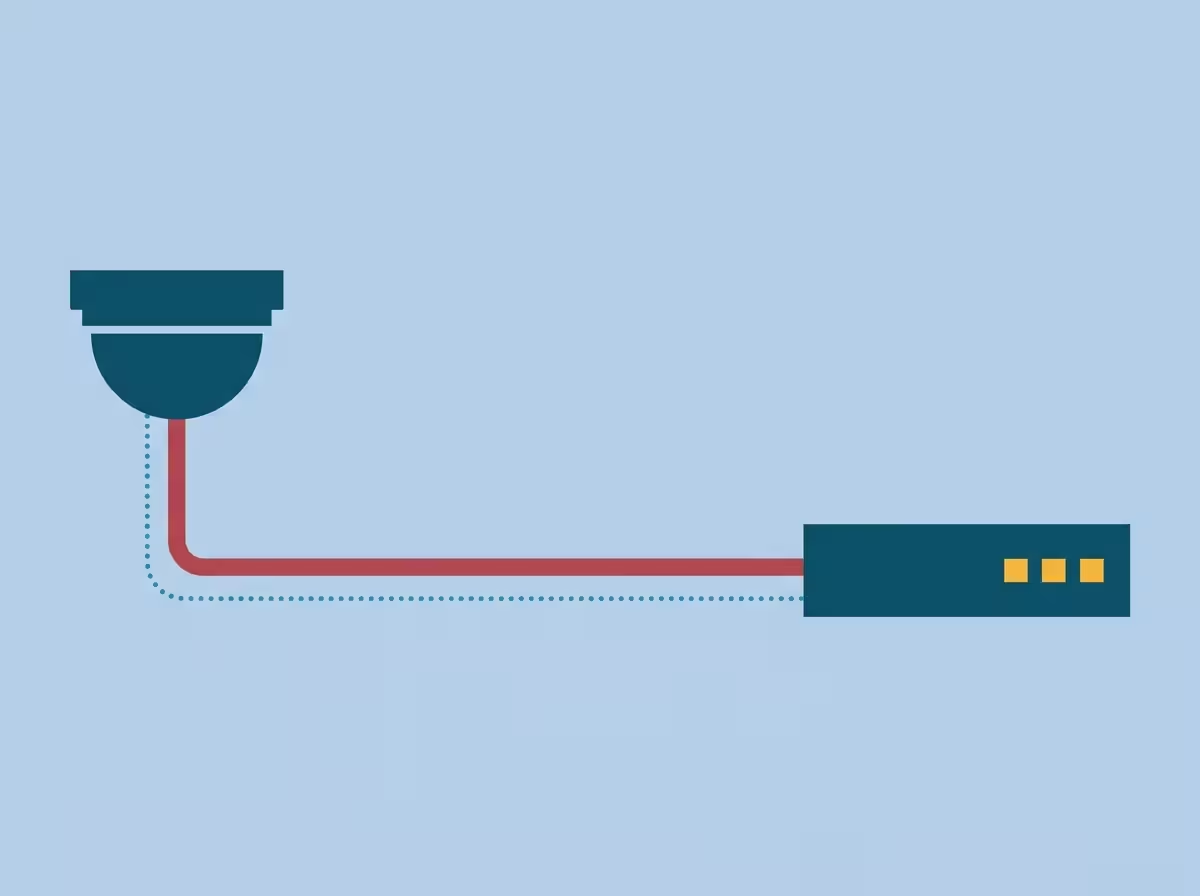
An analog camera transmits an image directly to a DVR video recorder via a coaxial cable. Power is supplied via a separate line—either from the nearest power source or via a common power cable running along the entire route. Modern analog is no longer the CCTV of the 90s; it is HD-CVI (Dahua), HD-TVI (Hikvision), and AHD technologies, which provide resolutions up to 5 megapixels over coaxial cable.
Advantages of an Analog System
Low cost. A kit of 4 cameras, a DVR, and cables for a shop or small office can be purchased from approximately 800 GEL. This is on average 1.5–2 times cheaper than an IP kit.
Simple installation. An analog camera can be installed by a team with basic experience, without knowledge of network configuration. The cable is run, the connector is crimped, the DVR is plugged into a 220V network, and the system is ready.
Compatibility with old cabling routes. If coaxial cable was laid 10–15 years ago and the routes are in good condition, it is possible to modernize the system without replacing the wiring. Only the cameras and the DVR are changed.
Stable operation. An analog signal does not depend on network parameters, IP conflicts, or DNS problems. The camera either works or it doesn’t—diagnostics are completed in a few minutes.
Limitations of an Analog System
Resolution limit. HD-CVI and HD-TVI standards support a maximum of 5MP. Higher quality requires switching to IP. 5MP is sometimes not enough to recognize a face or a license plate.
Distance limitation. A high-quality image is transmitted via coaxial cable up to about 300–500 meters. For longer distances, amplifiers or a switch to IP are needed.
Lack of on-camera analytics. An analog camera sends only a “raw” image, and processing happens on the DVR or manually. Modern features—intrusion detection, line crossing, object classification—either work poorly or do not work at all.
One cable — one camera. In multi-camera facilities, coaxial routes are distributed from the DVR in a star pattern, which increases the volume of cabling work.
When should you order an analog system?
Small shops, cafes, and pharmacies with 2–4 cameras for entrance and cash register control. Facilities with a limited budget where analytics are not required. Modernization of 10+ year-old analog systems where coaxial routes already exist and work. Also, facilities where stability and simple diagnostics without IT personnel are important.
How an IP video surveillance system works and why it is chosen more often in 2026
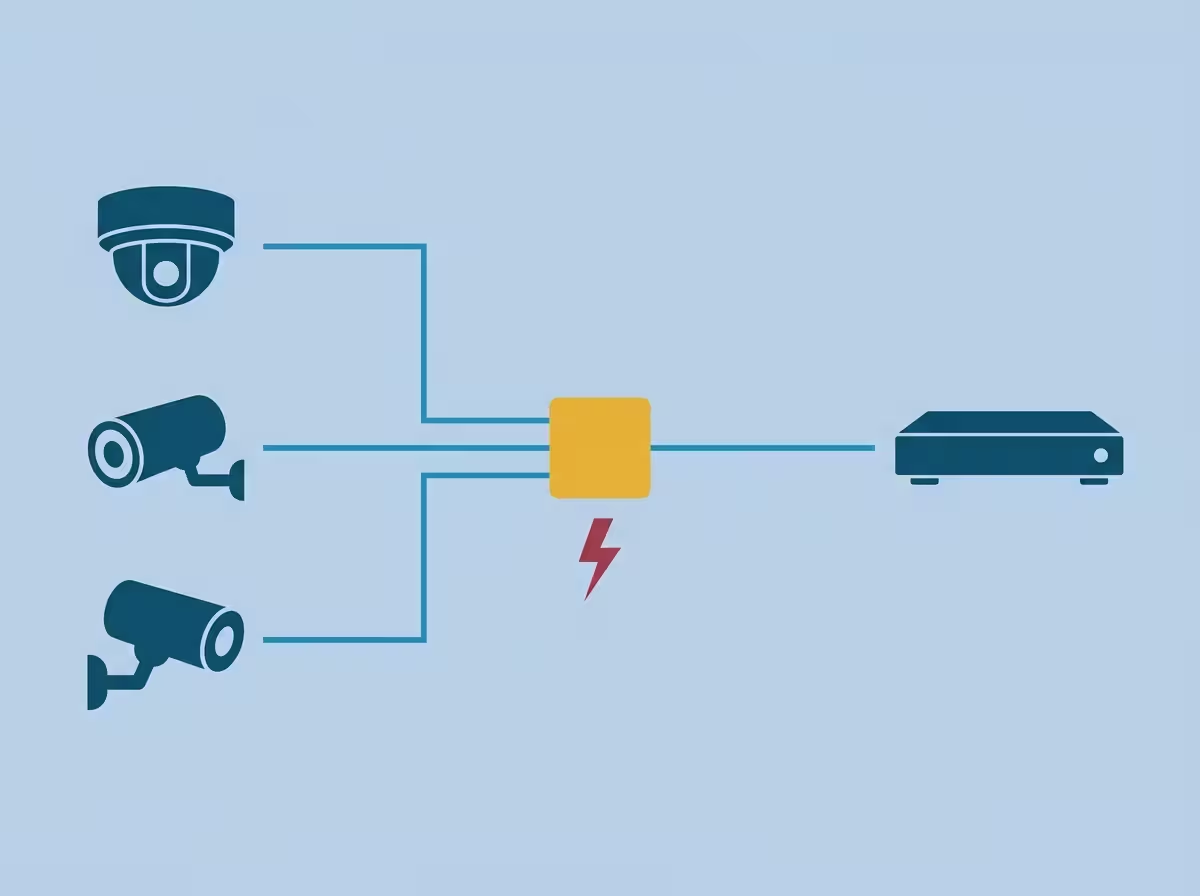
An IP camera is, in fact, a small computer with a built-in camera, network card, and analytical processor. It transmits a digital video stream via network cable (UTP, “twisted pair”) through a PoE switch to an NVR network recorder. Power is also supplied through the same cable—PoE (Power over Ethernet) eliminates the need to run separate power lines.
Advantages of an IP System
High resolution. Standard IP cameras operate in the 4-8MP range, while premium models reach up to 12-32MP. On a 4MP camera, it is possible to read a vehicle license plate from 30 meters away, and on an 8MP one—facial recognition from 15-20 meters.
Analytics on the camera. Modern Hikvision, Dahua, and Uniview IP cameras are equipped with neural network processors. The camera itself distinguishes between a person, vehicle, or animal, sends an alert when a virtual line is crossed, recognizes license plates, and counts visitors—without an additional server.
Power and signal in one cable. The PoE switch supplies power through the same UTP cable that transmits the video. One UTP cable replaces the coaxial cable and power line combined. At a facility with 20-30 cameras, this practically halves the number of cable routes.
Infrastructure flexibility. IP cameras connect to the building’s general network, and the image is available from any computer or smartphone via an application. The archive can be stored on an NVR, in the cloud, or on NAS storage.
Scalability. It is possible to install 4 cameras today and add another 8 in six months without redoing the infrastructure. New cameras simply connect to the switch.
Disadvantages of an IP System
Higher cost. A kit of 4 IP cameras, a PoE switch, and a 4-channel NVR starts from approximately 1,400 GEL. An 8-camera system starts from approximately 2,800 GEL. The exact price depends on the model and configuration.
Requirements for infrastructure. An IP system is part of the facility’s network. If the network is weak or poorly organized, the network must be modernized along with the installation of the video surveillance system. For large projects, this task is handled by Innocom—a subsidiary of Innotech.
Dependence on correct configuration. IP cameras require correct IP addresses, routing configuration, and sometimes working with VLANs. In the absence of IT personnel, the integrator takes on the service.
When should you order an IP system
Offices of medium and large businesses with 8+ cameras. Business centers and retail facilities where analytics and high-quality recognition are needed. Facilities where the video surveillance system is integrated with access control systems (ACS), security alarms, and parking systems. New installation on a clean site without existing cabling infrastructure. To order IP cameras for a facility, see the “IP Cameras” section. For system expansion, a PoE switch will be required.
Hybrid systems: IP and analog cameras in one network
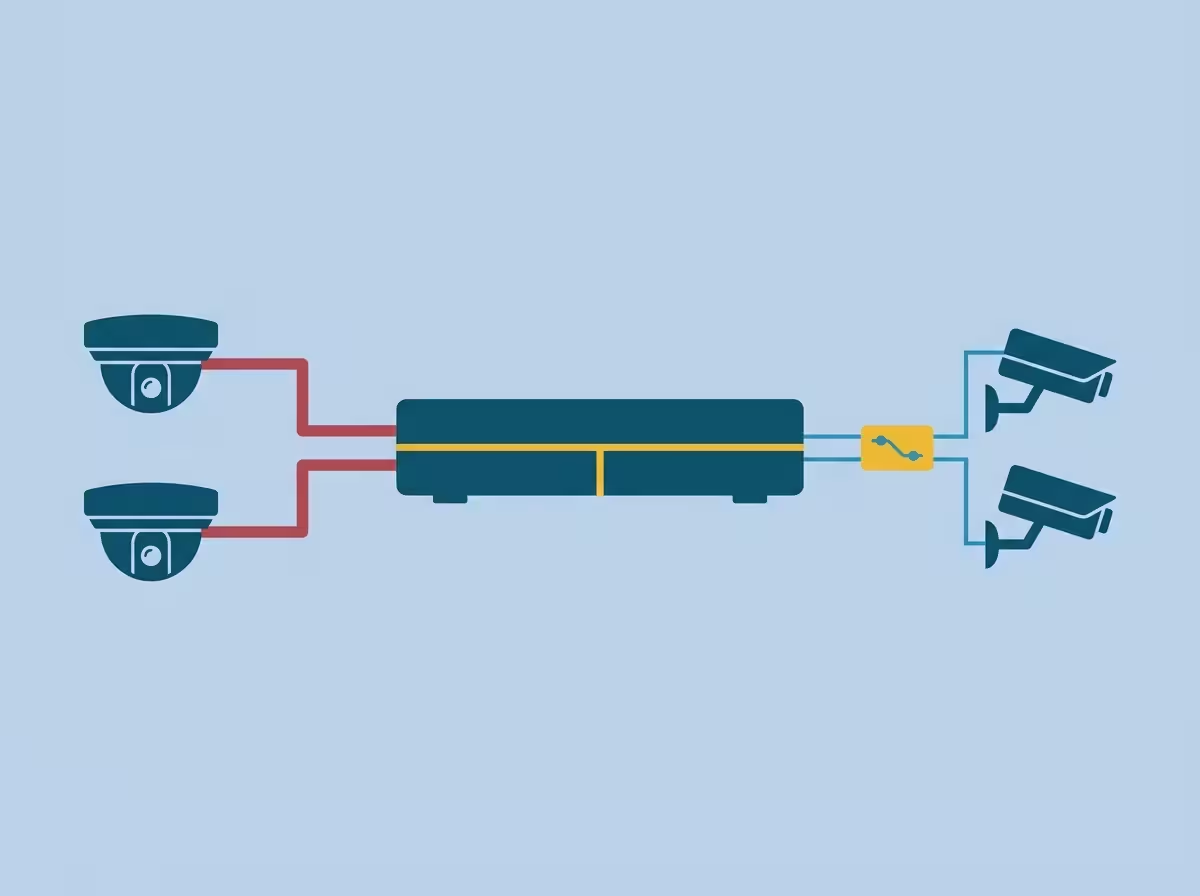
A hybrid XVR recorder receives both analog and IP cameras simultaneously. This provides engineering flexibility both for modernization and for working at mixed-type facilities.
Scenario for modernizing a shopping center: A facility opened in 2014 already has 12 analog cameras installed on the perimeter using coaxial cabling, which is in good condition. It is necessary to add 6 cameras with license plate recognition (LPR) for the parking lot and 4 analytical cameras for the entrance area. The optimal solution is to keep the existing analog cameras and replace only the recording device with a hybrid XVR, as well as add 10 new IP cameras on a PoE infrastructure. This reduces the budget by 30–40% compared to a complete replacement.
Second scenario — a mixed-type production complex with a large territory: Analog cameras with infrared lighting are used on the perimeter because stability and simple operation are important there, and analytics are not critical. IP cameras with specialized clothing recognition and zone control functions are used in production and office areas. One recorder and a unified monitoring system.
A hybrid system is not a compromise — it is the correct engineering solution. It is cheaper than a full IP system replacement and more flexible than a fully analog infrastructure. To order a hybrid recorder or to select a system for a mixed-type facility, see the section “DVR and NVR Recorders.”
What is important besides camera technology
Technology is only half the system. The other half is recording, archive storage, backup power, and analytics.
Recorder and archive storage
DVRs record analog streams, NVRs record IP streams, and XVRs record both. Disk capacity is calculated using the formula: number of cameras × average bitrate × days of archive × 24 hours. For 8 IP cameras with 4MP resolution and a 30-day archive, you need at least a 6TB disk. For 16 cameras — at least 12TB, often with two 8TB disks for reliability. The commercial standard is 24/7 continuous recording with additional event-based recording (motion, alarm). A 30-day archive covers the requirements of most facilities. In banks and jewelry stores, this period is often increased to 60-90 days.
Backup power
During a power outage, a regular video surveillance system shuts down in a few seconds. A 1000-1500VA UPS system keeps the system running for 30-60 minutes, which is sufficient in most cases. On critical facilities, a diesel generator or battery system is additionally used.
Analytics and neural networks
Modern IP cameras recognize typical scenarios: intrusion into a protected zone, virtual line crossing, left or removed items, crowd detection, exceeding capacity limits. License plate recognition (LPR) and facial recognition require specialized cameras with appropriate optics and a processor. Analytics capabilities depend on the camera model, lighting, and mounting conditions. During a site inspection, the camera is selected for a specific task — general surveillance, zone control, license plate recognition, or personal identification.
PTZ cameras with control and zoom
In large open areas (parking lots, warehouses, production perimeters), one controllable PTZ camera replaces 4–6 stationary cameras. The operator rotates the camera to any point in the territory, zooms in up to 100–150 meters for facial recognition, and controls the target in automatic tracking mode. Purchasing a PTZ camera is 3–5 times more expensive than a stationary one, but the savings on the number of cameras and cable lines often fully compensate for this difference. For additional information, see the section — “PTZ Cameras”.
Solutions for three typical facilities in Tbilisi
1. Shop or cafe with 4 cameras Analog HD-TVI or HD-CVI system with 2-5MP resolution. 4-channel DVR with a 2TB disk for a 30-day archive. Purchase and installation of such a kit can be done in 1-2 days. Budget — approximately 800-1,200 GEL with installation.
2. Office or small production with 8-12 cameras IP system with 4MP cameras, 16-port PoE switch, and 16-channel NVR with two 4TB disks. Basic analytics — motion detection and line crossing. Budget — approximately 4,000-7,000 GEL with installation. Installation time — 3-7 working days.
3. Warehouse, production, or shopping center with 20+ cameras High-resolution IP system with 4-8MP cameras and advanced analytics. 32-channel NVR, two 8TB disks in mirror configuration. Redundant PoE switches. PTZ cameras on the territory, stationary cameras on critical zones, and LPR cameras at the entrance. Integration with access control systems, security alarms, and parking systems. Budget — from approximately 18,000 GEL and up, depending on project complexity. Installation — 2-4 weeks with design and approval.
What to prepare before ordering a video surveillance system
For the first conversation with an integrator to be effective, prepare four key pieces of information:
Area of the facility and the number of critical zones (entrances, cash registers, warehouse, server room, parking, perimeter);
Installation conditions — whether a cable network exists, what type of cable it is, and what its condition is;
Analytics requirements — whether license plate, face, or zone control is needed;
Budget framework — this determines the choice between analog, IP, and hybrid systems.
With this data, a call to Innotech will take about 10-15 minutes, and you will get an understanding of the system’s composition and estimated cost. A precise cost estimate is drawn up after a specialist visits the site. Site inspection in Tbilisi is free.
To order the installation of a video surveillance system or to select specific equipment, see the section — Video Surveillance Systems.
Order video surveillance system installation in Tbilisi:
+995 595 532 112 Free site inspection.
Author: Morris Melia
Co-founder and CTO of INNOTECH, Tbilisi. 25+ years of experience in IT and security technologies. Certified partner of Hikvision, Dahua, Uniview, and Teletek. Holder of Cisco CCNA and VMware VCP certificates. Personally led hundreds of projects for business centers, hotels, residential complexes, and industrial facilities in Georgia.