


How to choose and buy a video surveillance camera for home

Buying a camera for an apartment or a private house rarely starts with a real understanding of technical differences.
In shops or online catalogs, there are dozens of models with similar descriptions: 2 megapixels, 4 megapixels, night mode, Wi-Fi, cloud. What really affects a camera’s performance at home and what is just marketing—it’s hard to understand without preparation.
This article bases the choice on four practical parameters: where the camera will be installed, how the system will connect, what resolution is actually needed at home, and which features justify the price. The goal is simple—to help you determine correctly which camera to order for a specific task and not to overpay for what you won’t actually need in an apartment or private house.
Where will the camera be installed: indoor or outdoor
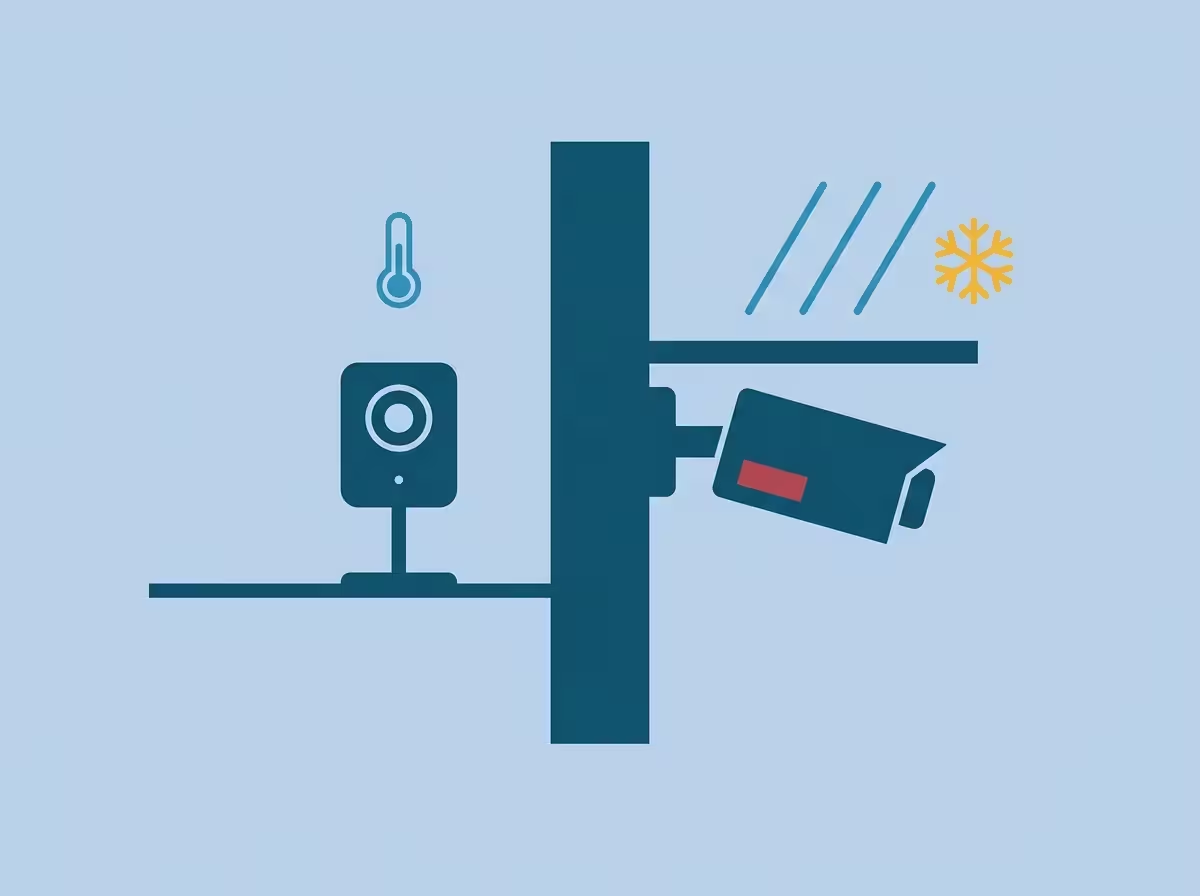
This is the first important choice. An indoor camera and an outdoor camera are two different classes of devices, not the same camera in different housings.
Indoor camera for an apartment or house
A compact body, lightweight plastic, operating temperature from +5°C to +40°C. It has no protection against water and dust. It often works on Wi-Fi and is powered by a standard 220V adapter. The design is intended for interior integration: dome-type models for shelves, rotating cameras with a swivel mechanism, and small cube cameras.
Standard use:
Entrance door control from the inside;
Monitoring children;
Monitoring pets while the owner is away;
Monitoring the living room or hallway.
A basic indoor camera can be purchased starting from approximately 80-150 GEL.
Outdoor camera for a private house or yard
The housing is made of metal or durable impact-resistant plastic. It is protected against water, dust, and sharp temperature changes. The operating range of -30°C to +60°C covers all climatic zones of Georgia—from the heat of Kakheti to the winters of mountainous regions.
The degree of protection is indicated by the IP standard:
IP65 — protection against water jets and dust, sufficient for a camera under a roof/overhang;
IP66 — withstands high-pressure water, suitable for installation on an open wall;
IP67 — protected against temporary submersion in water and is used in harsh conditions.
An outdoor camera is larger, heavier, and has a stronger lens and infrared illumination for night vision up to 20-50 meters. Power is mainly supplied via PoE, as Wi-Fi is more unstable outdoors due to walls and distance.
A basic outdoor camera can be purchased starting from approximately 200-350 GEL, while premium models start from 600 GEL.
What to choose for your specific facility
For an apartment where you need one point of control for the entrance — a compact indoor Wi-Fi camera.
For an apartment with several control zones — a set of 2-3 indoor cameras in one application.
For a private house, yard, and perimeter control — outdoor cameras with IP65 or IP66 protection.
For a mixed scenario — outdoor cameras for the yard and 1-2 indoor cameras for the house, combined into one system.
For outdoor installation, additional accessories are often needed:
Mounts;
Lightning protection;
Installation boxes.
Wi-Fi or Cable: How to choose a camera for apartment conditions
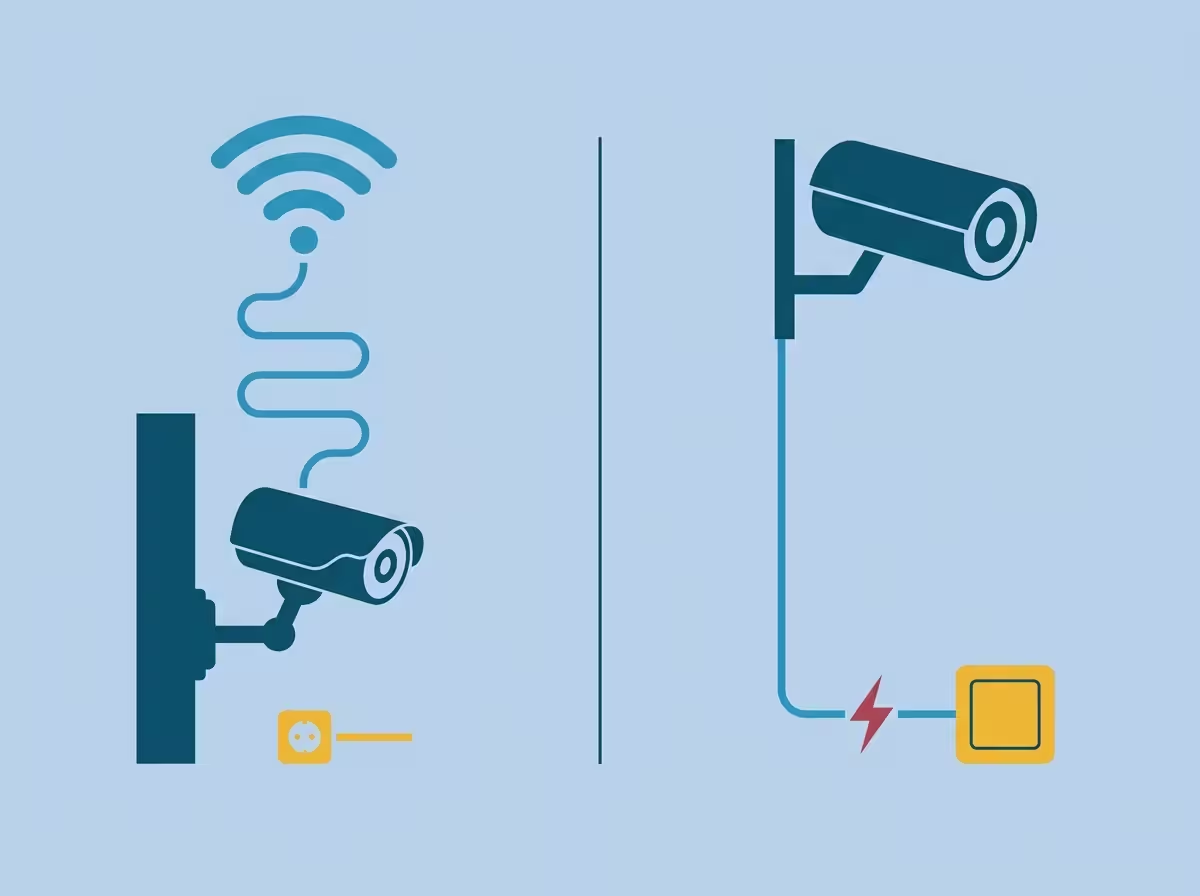
The connection method determines the system’s reliability, installation difficulty, and final price.
Wi-Fi camera: Purchase and installation in one hour
Installation itself takes 30–60 minutes. The camera is mounted on a wall or placed on a shelf, plugged into a 220V outlet, and the home Wi-Fi password is entered in the smartphone app. In a few minutes, the camera goes online and the image is available from anywhere via the internet.
Strengths: No need for cable routing or drilling holes in walls—except for mounting holes.
The camera can be moved to another room in a minute. The price is low due to
the absence of installation work—a Wi-Fi kit with 2–3 cameras costs around 400–700 GEL, including installation.
Weaknesses: The camera depends on the stability of the Wi-Fi router.
If the internet goes down for an hour, the archive for that time is lost.
If there is a weak signal in a distant room, the image will be pixelated or delayed. In a yard 10–15 meters from the router, Wi-Fi does not pass well through stone walls, and this becomes a problem in summer houses or large private homes. A Wi-Fi camera can be disconnected from the network by jamming the signal.
When to choose: 1–3 room apartment where Wi-Fi stably covers all zones. A small summer house without strict reliability requirements. Temporary monitoring during renovations or vacations. To order a Wi-Fi camera for an apartment, see the “Wi-Fi Cameras” section.
Wired IP camera with PoE: A stable solution for years
The camera is connected with a single network UTP cable (twisted pair) to a PoE switch or an NVR video recorder with PoE support. Power is supplied to the camera via the same cable—no separate 220V cable is needed. A camera installed outdoors receives power from a device located inside the house, which eliminates external electrical connections.
Strengths: A stable image without dependence on Wi-Fi or the router.
The archive is stored on a separate recorder and cannot be deleted remotely via the internet.
A single cable up to 100 meters long covers any point of a private house or large apartment. The camera cannot be disabled without physical access to the cable.
Weaknesses: Requires routing cables from each camera to the recorder.
In a renovated apartment, this means wall chasing (grooving) or routing in cable channels. In a private house under construction, the cable fits into the walls without problems, while in a finished house, it requires advance route planning.
A full-fledged wired system of 4 cameras and a recorder starts from 1,200 GEL including installation.
When to choose: A private house, especially at the construction or renovation stage. A large apartment with several cameras in different zones. A facility where reliability is important—for example, if parents have left the house for a year, a summer house located in a remote area, or if valuable property is kept in the house. To choose a wired system and order installation, see the “IP Cameras” and “PoE Switches” sections.
Resolution and viewing angle: What is actually needed at home
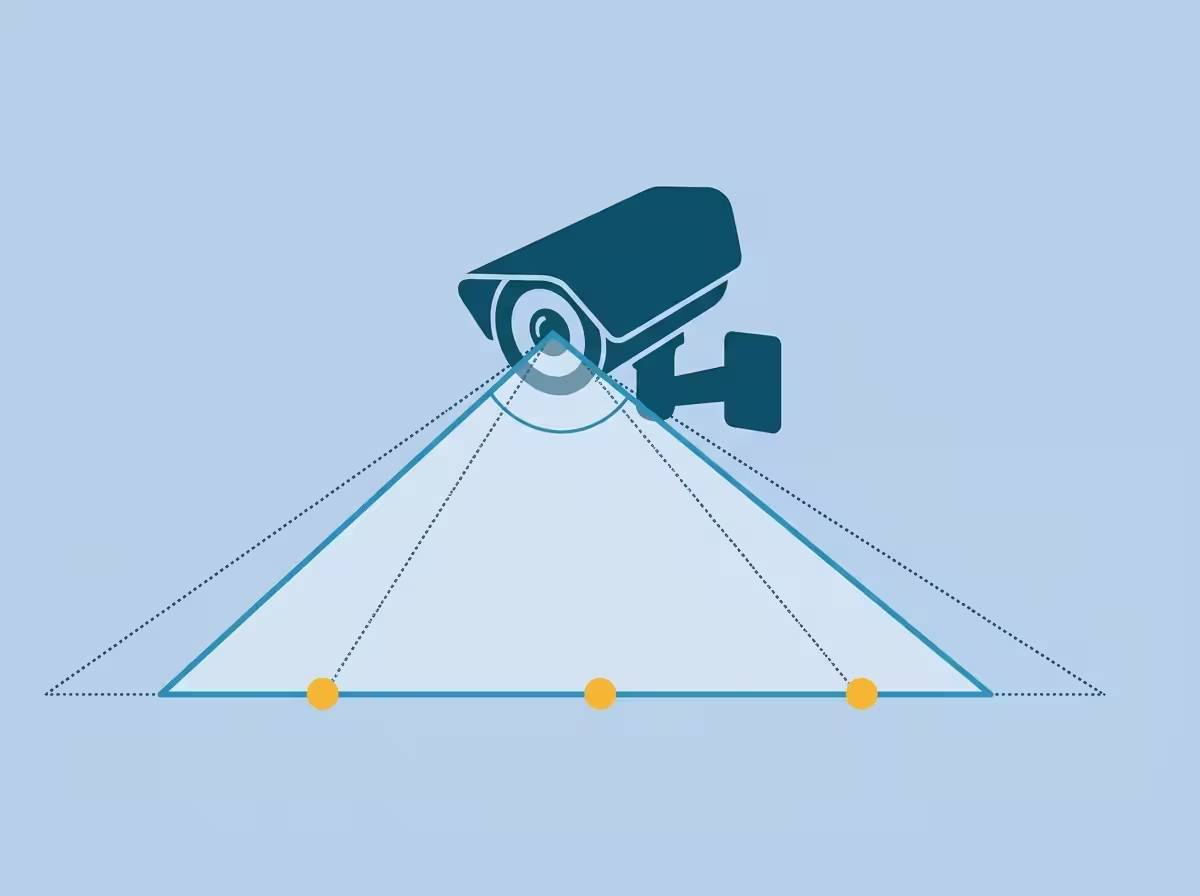
On camera packaging, megapixels are indicated most prominently—2MP, 4MP, 8MP. In practice at home, the viewing angle and lens quality are more important than just the number of megapixels. Excessively high resolution increases archive volume and the cost of cloud or local storage.
What resolution is optimal
2 Megapixels (Full HD 1920×1080) — Sufficient for most home needs. Facial recognition up to 5-7 meters, a full picture of the room or yard is clearly visible.
4 Megapixels (2560×1440) — Significantly better detail. Facial recognition at 8-12 meters. Makes sense for yard cameras.
8 Megapixels (4K) — Usually excessive for home. Justified only in large areas or when controlling a long perimeter.
Viewing angle is more important than megapixels
90° — Deep, but narrow image.
110-120° — Optimal option for an apartment and house.
180° — Panoramic image for the entire space, though with “fisheye” deformation.
Additional features: What really works and what is just marketing
Night vision: Infrared or color
Infrared illumination is now a standard. The camera switches to black-and-white mode in low light and illuminates with infrared LEDs. Color night vision is a new generation feature. Thanks to a strong matrix and optics, the camera retains color even in low-light conditions. This increases the camera price by about 30-50%, but provides a significantly better result for the street.
Two-way audio
A microphone and speaker allow you to talk to a person in the camera zone from an application. Useful for children, communication with couriers, and pet control.
Motion detection and notifications
On cheap cameras, motion detection often reacts to trees, animals, and shadows. As a result, the user receives dozens of false notifications. Modern cameras with analytics distinguish between a person, car, and animal. This feature increases the camera price by about 100-200 GEL, but it really justifies itself.
Where is the recording stored: SD card, NVR, and cloud
SD-card in the camera itself — the simplest option. A 128 GB card from one 2MP camera stores continuous recording for 5–7 days. Downside: if the camera is stolen or damaged, the archive is lost with it.
Cloud storage via the camera manufacturer (Hikvision, EZVIZ, Dahua).
The archive is recorded on the manufacturer’s servers and is available from the application.
Downside: paid subscription—30–100 GEL per month per camera, as well as dependence on the internet and the manufacturing company.
Network NVR recorder — the optimal option for a system with several cameras.
The recorder stands in a hidden place in the house, stores the archive on a built-in disk, and is not dependent on the cloud or internet.
For 4 cameras, a 30-day archive requires a 2 TB disk. This is the option for a private house or a large apartment with several cameras.
See more information in the “DVR and NVR Recorders” section.
Three typical scenarios: What to order for an apartment or house
1. One camera at the entrance door
2MP Wi-Fi camera, 110-120° viewing angle, infrared night vision, and recording on an SD card. Cost approximately 150-300 GEL.
2. Set of 2-3 cameras for an apartment
2MP indoor cameras for main zones: hallway, living room, children’s room. Budget—approximately 500-900 GEL for equipment and 200-400 GEL for installation.
3. Full-fledged system for a private house with 4-6 cameras
Wired IP system with outdoor cameras for the yard and perimeter, indoor cameras for common zones, PoE switch, and 8-channel NVR recorder. Budget—approximately 2,500-6,000 GEL including installation.
What you should define before contacting a specialist
How many cameras you need and where they will be installed;
Whether the apartment is under renovation or finished;
What budget you want to fit into;
Where the archive should be stored—on an SD card, in the cloud, or on an NVR.
With this data, a call to Innotech will take about 10-15 minutes, and you will get an understanding of the system’s composition and estimated cost. A precise cost estimate is drawn up after visiting the facility. Inspection in Tbilisi is free. If you have doubts about the decision, you can consult with our manager.
To choose specific devices, see the catalog sections:
Wi-Fi Cameras;
IP Cameras.
Our specialist will help you choose accessories and recording devices based on your facility and task.
Order home video surveillance system installation in Tbilisi: +995 595 532 112
Author: Morris Melia Co-founder and CTO of INNOTECH, Tbilisi. 25+ years of experience in IT and security technologies. Certified partner of Hikvision, Dahua, Uniview, and Teletek. Holder of Cisco CCNA and VMware VCP certificates. Personally led hundreds of projects for business centers, hotels, residential complexes, and industrial facilities in Georgia.