

Business Notification and Evacuation System in Tbilisi

During emergencies, an emergency warning and evacuation system controls human behavior.
It is neither a background music system nor ordinary speakers. The safe exit of shopping center visitors in five minutes, or whether they panic and crowd at a single exit, depends on its operation. It determines whether hotel guests will hear an alarm signal at night and understand where to go when they were sound asleep five minutes prior.
In most commercial facilities with high occupancy, such a system is mandatory. These include hotels, shopping centers, multi-story office buildings, industrial complexes, and educational institutions. Specific requirements for the system’s composition and characteristics are determined by a design project developed by engineers and governed by Georgian fire safety standards.
Beyond mandatory cases, warning systems are often ordered on a voluntary basis for restaurants, banquet halls, sports complexes, and medical centers. The reason is simple: well-organized evacuation during an incident saves lives and protects the business’s reputation.
Below, we will discuss what the system consists of, what types of alerts exist, how it integrates with fire alarms and access control, and what you need to prepare before ordering an installation.
What the Warning System Consists Of
A complete system consists of five components. Each performs its function; without any of them, the system does not work as a complex unit.
Sound Amplifiers
The heart of the system. The amplifier receives a signal from the microphone console or the fire alarm panel (in the form of a recorded voice message), amplifies it, and delivers it to speakers according to the facility’s zones. Power is selected based on the total load of the speakers and the number of zones. In large facilities, several amplifiers are installed with redundancy. If one fails, the load automatically switches to the backup, and the warning does not stop. You can order amplifiers for your facility in the “Amplifiers” section.
Various Types of Speakers
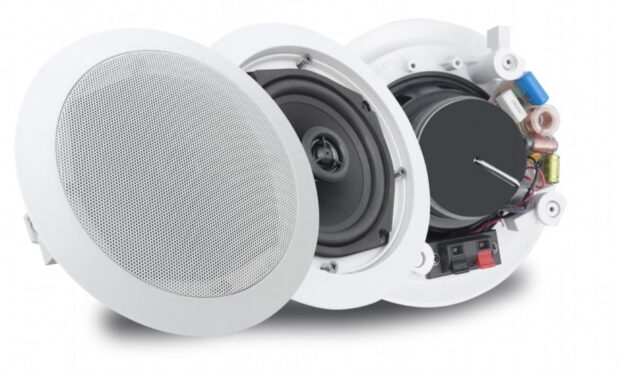
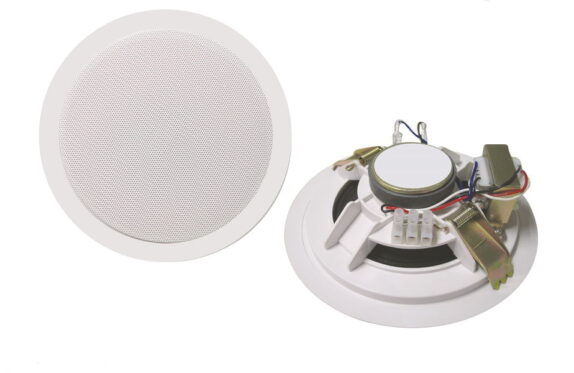
Ceiling speakers: Installed in suspended ceilings. Used in offices, hotel corridors, and shopping halls. They provide even sound distribution without visible structures.
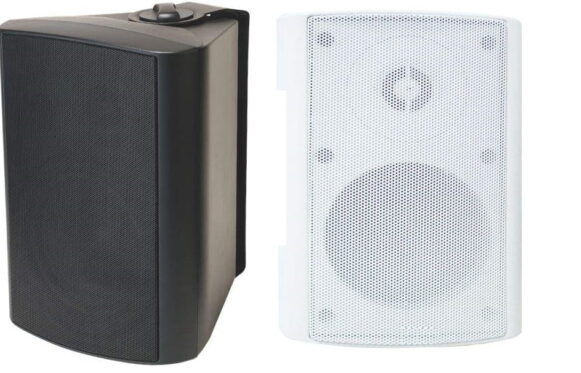
Wall-mounted speakers: Attached to walls. Used in buildings without suspended ceilings: production workshops, warehouses, parking lots, and technical areas.
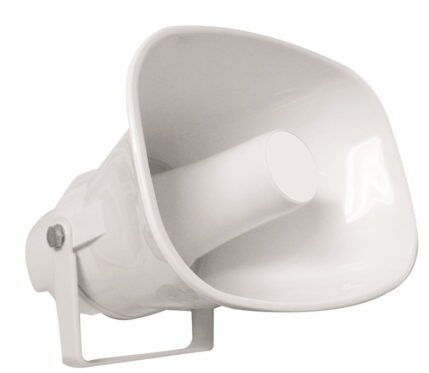
Horn speakers: Used in open areas and large, noisy buildings: street parking areas, factory floors, and storage hangars. They have significantly higher sound power and directivity. Different models of speakers are required for different types of buildings. You can select equipment in the “Amplifiers” section.
Microphone Console
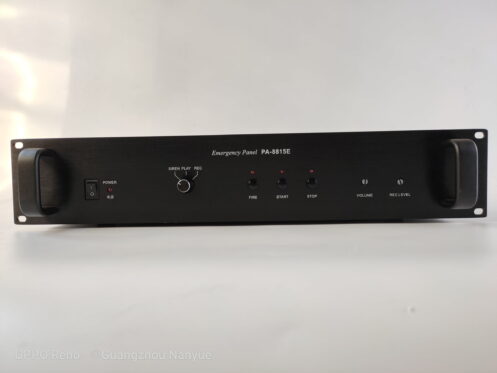
An operator’s console located at the reception, security post, or dispatch room. Through the console, the operator manually triggers alerts in selected zones. This is important for non-standard situations unrelated to fire: evacuation during threats, announcements about a lost child in a shopping mall, or coordinating staff actions. The console works in conjunction with automatic triggering from the fire alarm panel.
Emergency Lighting and Illuminated Evacuation Signs
Emergency lighting turns on when the main power grid is disconnected or during an alarm signal. It ensures the visibility of evacuation routes in smoke and darkness. Illuminated exit signs with arrows work in normal mode as a guide and switch to an enhanced mode during an alarm. You can select equipment in the “Emergency Lighting” section.
Backup Power Supply
Rechargeable batteries ensure the system operates in the event of a power outage. Specific requirements for the duration of autonomous operation and the composition of the backup power are determined by the project. Facilities where people are present all day require a larger capacity.
Types of Warning Systems by Number of Zones
Warning systems vary by the number of independent broadcast zones. The number of zones determines the price, the flexibility of scenarios, and the options for use on the site.
Single-zone system: All speakers work as one zone. When triggered, the message is heard simultaneously throughout the entire room. Suitable for small facilities with one common space: a shop up to 200–300 square meters, a cafe, a small office, or a small warehouse with open zones.
Two-zone system: Two independent broadcast zones. The operator triggers alerts for the zones separately or simultaneously. Used for facilities that are naturally divided into functional parts: a restaurant with two halls, a small office with a retail and warehouse section, or a hotel with separate zones.
Multi-zone system: Such a sophisticated system can have anywhere from three to dozens of independent zones. Every floor, every wing, and every functional area of the facility is informed separately or in any combination. Multi-zone systems are used in large hotels, shopping malls, multi-story business centers, and large industrial complexes. The installation of such a system is always an individual project, developed taking into account the specific layout, building features, and business processes of the enterprise.
Voice Message or Siren
A siren emits a short, loud, disturbing signal without speech. People understand there is a danger, but not what to do. Sirens are used in simple facilities and for basic fire signaling in small areas.
Voice messages play recorded instructions such as: “Attention, smoke has been detected. Please evacuate the building immediately via the emergency exits.” Messages are transmitted zone-by-zone with delays: the fire zone receives the signal first, and other zones follow after 30–60 seconds for an orderly evacuation. Voice messaging is used in hotels, shopping malls, and medium-to-large business centers.
Integration with Fire Alarms and Access Control
The warning system works together with two adjacent systems: the fire alarm and access control. These are not three separate projects, but a unified engineering complex of the facility’s security.
What happens automatically during an alarm: At 03:47, a smoke detector in the third-floor corridor of a hotel detects smoke. The signal goes to the fire panel. The panel identifies the detector, verifies it is not a false alarm, and initiates the alarm scenario. A staff member verifies the information personally or via CCTV.
In the first few seconds, the warning system plays a voice message in the fire zone and the floor above: “Attention, smoke has been detected. Please leave your room immediately and proceed to the nearest emergency exit.” After 30–60 seconds, the message begins in the adjacent zones. Emergency lighting turns on, and evacuation signs are activated. The access control system unlocks all doors on evacuation routes: magnetic locks are deactivated, and electromechanical locks switch to an open state. Exterior sirens sound loudly for arriving fire brigades.
The entire scenario starts automatically but under the control of security personnel. Without integration, these processes are carried out manually by the duty administrator, which is impossible during a real fire and creates additional risks to human life and health.
What to Prepare Before Ordering Installation
Before your first conversation with the integrator, gather these five items:
Type and purpose of the facility: Hotel, shopping mall, business center, industrial facility, restaurant, banquet hall.
Area, number of floors, and number of individual functional zones.
Presence of an existing fire alarm on the site. If it already exists, the warning system is integrated with it. If not, both systems are ordered as one project.
Requirements for zoning and warning languages.
Existence of a ready-made project or the need to develop one. If a project exists, installation starts immediately. If not, Innotech organizes the design through a partner as part of the general contract.
With this data, a call to Innotech will take 15–20 minutes, resulting in an understanding of the work scope and estimated cost. A precise estimate is prepared after a specialist visits the site.
Order the installation of a notification and evacuation system in Tbilisi: +995 595 532 112
Equipment can be previewed in the catalog: Evacuation Systems. Free site inspection.
Author: Morris Melia Co-founder and CTO of INNOTECH, Tbilisi. 25+ years of experience in IT and security technologies. Certified partner of Hikvision, Dahua, Uniview, and Teletek. Holder of Cisco CCNA and VMware VCP certificates. Personally led hundreds of projects for business centers, hotels, residential complexes, and industrial facilities in Georgia.